প্রকাশের তারিখ : ০৪ নভেম্বর ২০২৬
Prime Minister seeks Beijing’s help on Rohingya crisis, eyes wider economic ties
||
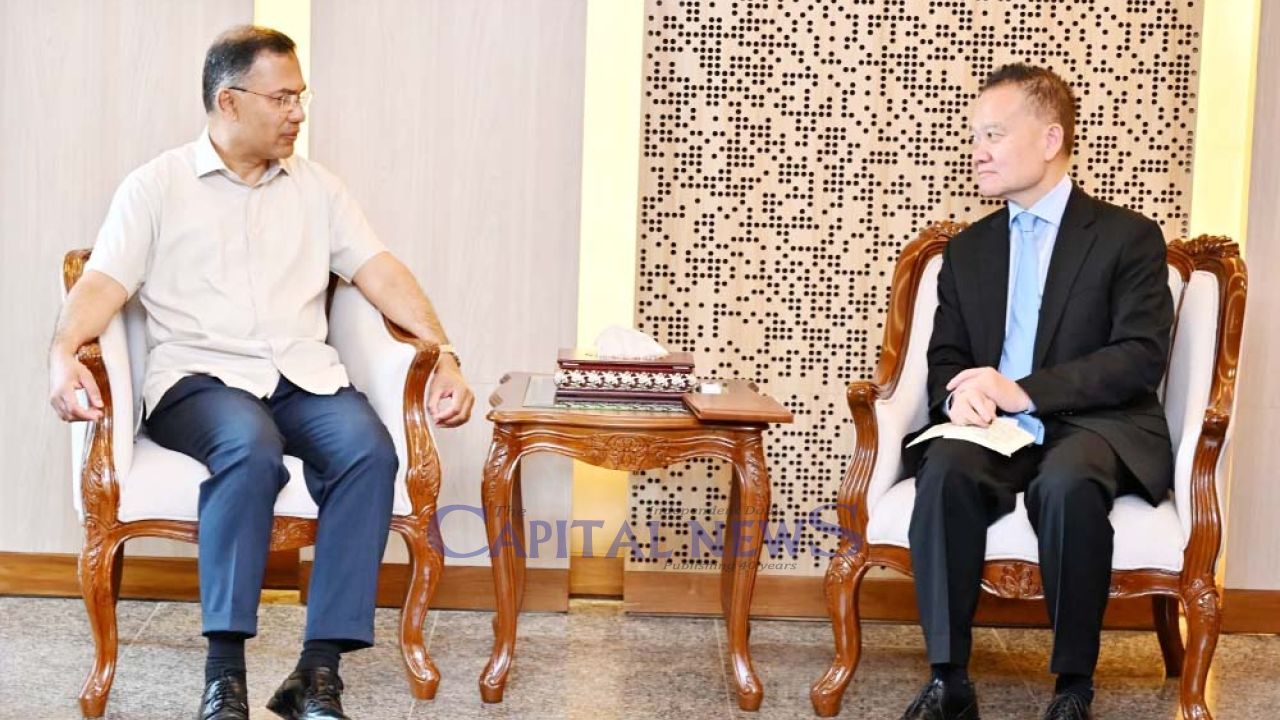
Liu Haixing assures Dhaka that Prime Minister’s concerns will be conveyed to Xi Jinping; broader cooperation discussed on trade, investment, regional connectivity and party relationsMM Rahmatullah: Bangladesh has called on China to play a more active and effective role in resolving the protracted Rohingya crisis, as Prime Minister Tarique Rahman highlighted the growing economic, social, demographic and environmental challenges created by the presence of around 1.3 million forcibly displaced Myanmar nationals in the country.The Prime Minister made the appeal during a courtesy meeting with Liu Haixing, Minister of the International Department of the Communist Party of China (CPC) Central Committee, at the Prime Minister’s Office at Bangladesh Secretariat on Wednesday.Liu assured the Prime Minister that Beijing was aware of the Rohingya crisis and would convey Dhaka’s concerns to Chinese President Xi Jinping.The assurance carries diplomatic significance for Bangladesh, which has long been seeking China's stronger engagement with Myanmar to create conditions for the safe, voluntary, dignified and sustainable repatriation of Rohingyas to their homeland.For Bangladesh, the prolonged displacement is no longer simply a humanitarian concern. It has become a major development and economic challenge, putting pressure on public resources, local communities, employment opportunities, the environment and social stability, particularly in Cox's Bazar and surrounding areas.With China maintaining important diplomatic and economic relations with Myanmar, Dhaka considers Beijing an influential partner whose engagement could help create momentum towards a lasting solution.The Prime Minister's appeal reflects Bangladesh's continued efforts to internationalise the Rohingya issue and secure meaningful support from influential regional and global powers.The presence of approximately 1.3 million Rohingyas has placed a substantial burden on Bangladesh, despite the country having limited resources and its own development priorities.The crisis has affected local infrastructure, natural resources and the livelihoods of host communities. The prolonged uncertainty over repatriation has also increased concerns about the future of displaced families and the stability of the region.China's willingness to communicate Bangladesh's concerns directly to President Xi Jinping could provide an opportunity to renew high-level discussions on the issue.However, the real test will be whether diplomatic assurances can translate into practical initiatives, particularly through China's engagement with Myanmar.Beyond the Rohingya issue, the meeting highlighted the two countries' shared interest in expanding bilateral relations across economic, political and development sectors.Liu conveyed President Xi Jinping's greetings to Prime Minister Tarique Rahman. In response, the Prime Minister sent his greetings to both Xi Jinping and Chinese Premier Li Qiang.Recalling the joint declaration on a new era of bilateral relations announced during Tarique Rahman's visit to Beijing, Liu expressed hope that cooperation between the two countries would expand in line with the commitments made in the declaration.He also reiterated that China's commitment to Bangladesh's development remained unchanged and expressed confidence in Bangladesh's economic growth and development prospects under the Prime Minister's leadership.For Bangladesh, China remains an important development partner, particularly in infrastructure, industrial development, investment, trade and technological cooperation.The two sides' discussions suggest that both Dhaka and Beijing are interested in maintaining political understanding while widening practical economic cooperation.Regional connectivity and economic integration also featured prominently in the discussion.The two sides exchanged views on the Bangladesh-China-Myanmar Economic Corridor, an initiative that could potentially strengthen transport links, trade and investment opportunities among the participating countries.Improved regional connectivity could help Bangladesh expand its access to neighbouring markets, attract investment and strengthen its position in regional supply chains.Liu also said China supported Bangladesh's inclusion in the Regional Comprehensive Economic Partnership (RCEP), one of the world's major free-trade arrangements.Such support is significant as Bangladesh seeks to diversify its export markets, attract foreign investment and strengthen its competitiveness in the changing global trading environment.For Bangladesh, greater participation in regional economic arrangements could open up opportunities for exporters, manufacturers and service providers. However, the country would also need to improve industrial productivity, infrastructure, trade facilitation and regulatory capacity to benefit fully from deeper economic integration.The discussions therefore point towards a potentially broader economic partnership, extending beyond traditional infrastructure cooperation.The meeting also placed considerable emphasis on strengthening relations between the Communist Party of China and the Bangladesh Nationalist Party (BNP).Liu said Beijing wanted to expand and diversify party-level relations and invited a BNP delegation led by the party's Secretary General to visit China.Closer institutional engagement could create additional channels for political communication, experience-sharing and mutual understanding between the two countries.The Prime Minister, meanwhile, recalled the historical foundations of Bangladesh-China friendship, saying that the foundation of bilateral relations had been laid during the tenure of Shaheed President Ziaur Rahman.He said it was now their responsibility to carry that friendship forward to future generations.The reference to Ziaur Rahman's historic engagement with China underlined the BNP government's intention to maintain continuity in Bangladesh's longstanding relationship with Beijing.An interesting part of the discussion concerned Bangladesh's water management and agricultural development.Recalling Ziaur Rahman's visit to China, the Prime Minister said that it was followed by the introduction of a canal excavation programme in Bangladesh, which gained widespread popularity and contributed to agricultural development.Tarique Rahman said the present government had undertaken an initiative to excavate 20,000 kilometres of canals.The programme is intended to benefit farmers, improve water management, preserve biodiversity and maintain environmental balance.If implemented effectively, the initiative could help improve irrigation facilities, reduce waterlogging, support agricultural production and restore important local ecosystems.For a country where agriculture remains an important source of employment and livelihood, effective water management is closely connected with food security, rural income and climate resilience.The reference to the historical canal programme also demonstrated how the government intends to connect its development priorities with the political and diplomatic legacy of the BNP.The meeting between Prime Minister Tarique Rahman and Liu Haixing comes at a time when Bangladesh is seeking to strengthen its international partnerships while addressing pressing economic and humanitarian challenges.Three issues stand out from the discussions: securing China's meaningful engagement in resolving the Rohingya crisis, expanding economic cooperation through regional connectivity and trade, and strengthening political and institutional relations.For Dhaka, the immediate priority remains finding a durable solution to the Rohingya crisis without compromising regional stability or its own development interests.At the same time, Bangladesh needs greater foreign investment, diversified export markets, improved infrastructure and stronger regional economic partnerships to sustain its growth ambitions.China's assurance of continued support, its willingness to convey Bangladesh's concerns to President Xi and its backing for greater regional economic integration provide a positive diplomatic signal.Nevertheless, the success of this engagement will ultimately depend on concrete outcomes: progress towards Rohingya repatriation, increased investment, expanded trade opportunities and the effective implementation of mutually agreed development projects.The meeting has therefore opened another important diplomatic window for Bangladesh. The challenge now is to turn political goodwill into measurable benefits for the country's economy, people and long-term national interests.BNP Standing Committee Member Nazrul Islam Khan, Acting Secretary General Advocate Ruhul Kabir Rizvi, Vice-Chairman Air Vice-Marshal (retd) Altaf Hossain Chowdhury and State Minister for Foreign Affairs Shama Obaed Islam attended the meeting.The Chinese delegation included Chargé d'Affaires of the Chinese Embassy in Dhaka Dr Liu Yuyin, Director General of the CPC International Department's Bureau of Southeast and South Asian Affairs Peng Xiubin and other senior officials.The information about the meeting was provided by Prime Minister's Deputy Press Secretary Shahadat Shadhin.
© 2025 The Daily Capital News