প্রকাশের তারিখ : ০৬ নভেম্বর ২০২৬
Chhatra Shibir unveils 2027 publications highlighting Islamic heritage
||
DU
Correspondent: Bangladesh
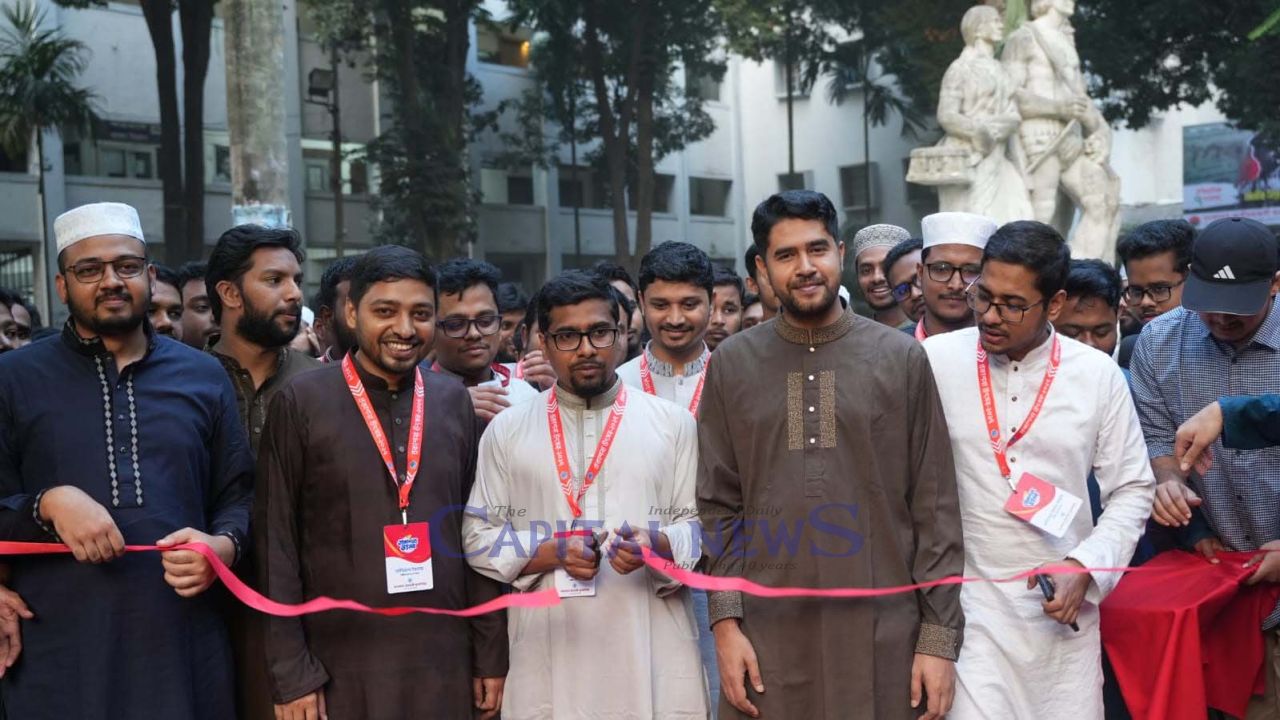
Islami Chhatra Shibir, the student wing of Bangladesh Jamaat-e-Islami, on
Friday unveiled its 2027 New Year publications at a colourful ceremony at Bot
Tola on the Dhaka University campus, highlighting Muslim heritage, historical awareness,
social responsibility and Bangladesh’s geopolitical and national interests.The
publication unveiling and festival began at 3:30pm, drawing students from Dhaka
University and other educational institutions, as well as members of the public
and families.Shibir
Central President Nurul Islam attended the programme as the chief guest, while
Secretary General Sibgatullah, Central Office Secretary Azizur Rahman Azad and
Dhaka University Central Students’ Union (DUCSU) Vice-President Abu Sadiq Kayem
were present.The
event was conducted by the organisation’s Central Publication Secretary Amirul
Islam.The
2027 publication collection features a range of Bangla and English diaries,
pocket and medium-sized diaries, notebooks, year planners and different types
of calendars, combining artistic presentation with historical and educational
content.A
notable feature is the Bangla diary cover, inspired by the Mughal-era
terracotta ornamentation of the historic Atia Mosque in Tangail. The diary also
includes important events from world history for each day and introductions to
contemporary books, aiming to encourage students to develop an interest in
history and reading.The
desk calendar presents illustrated accounts of 12 historic mosques associated
with Islamic civilisation, including Hagia Sophia, the Great Mosque of Cordoba
and Masjid al-Quba.One
of the major attractions is a research-based publication titled 'Three-Page
Calendar', which focuses on issues of national and strategic importance. Its
subjects include Bangladesh’s geopolitics, border security, equitable sharing
of river waters, the strategic importance of the Bay of Bengal and the blue
economy, Muslim identity and heritage, and data sovereignty.The
collection also includes a specially designed year planner with monthly and
daily routine charts to help students manage their time, practical diaries with
leather and gel bindings, and a single-page calendar featuring calligraphy of a
verse from Surah Ibrahim.Addressing
the gathering, Shibir President Nurul Islam said the publications were the
outcome of extensive research and thoughtful planning, with themes reflecting
Bangladesh’s development aspirations and the history and heritage of Muslim
civilisation."We
believe in aesthetics, creativity and building a research-oriented
society," he said, stressing the need to develop young people morally and
ideologically to address challenges such as moral decline, drug addiction,
juvenile gangs and broader social deterioration.He
said Shibir was working to promote personal discipline and Islamic values among
young people through training programmes and the distribution of research-based
publications, periodicals, science magazines and religious books.Despite
various challenges, the organisation had continued the initiative this year, he
added."Our
publications are not merely gift items or sources of entertainment. Through
them, we want to convey messages of history, heritage, knowledge, science and
morality to students, families, guardians and the wider intellectual
community," Nurul Islam said.He
described the development of critical thinking, research and creativity among
the younger generation as one of the organisation's key objectives.Shibir
Secretary General Sibgatullah said attempts had repeatedly been made to
obstruct the organisation's activities, but it had sought to win over ordinary
students through creativity, quality and aesthetic presentation rather than
intimidation.Referring
to the previous 16 years of political rule, he alleged that Bangladesh had
remained subservient to hegemonic forces during that period.He
said the organisation had incorporated Bangladesh's geographical position,
history, heritage, challenges and potential into its publications to promote
national awareness and confidence.DUCSU
Vice-President Sadiq Kayem, speaking as a special guest, recalled what he
described as restrictions on religious expression at Dhaka University in the
past.He
alleged that while Marxist, Leninist and materialist philosophies could be
discussed openly, students faced harassment and show-cause notices for
organising Quranic gatherings or discussing Islam."Today,
their successors are holding a public publication festival at this very Bot
Tola," he said.Kayem
also said Shibir sought to promote a form of student politics based on
creativity and nation-building rather than extortion, tender manipulation and
campus domination.Through
positive and welfare-oriented politics, he said, the organisation aimed to
develop a generation capable of contributing to an equitable Bangladesh.Central
Office Secretary Azizur Rahman Azad alleged that Shibir's constructive
activities had not received adequate opportunities for public presentation over
the past 16 years. He
said the organisation had been working since its establishment towards building
a civilised society based on justice and fairness, adding that more than 300 of
its members had been killed while pursuing that goal.Following
the unveiling ceremony, the leaders visited different publication stalls, where
visitors examined the products, purchased diaries and calendars and selected
publications as gifts for family members and friends.Among
those attending were Central Treasurer Anisur Rahman, College Affairs Secretary
Hafiz Yusuf Islahi, Higher Education and Research Secretary Md Fakhrul Islam,
Publicity Secretary SM Farhad, Social Welfare Secretary and RAKSU
Vice-President Md Mostakur Rahman Zahid, HRD Secretary Helal Uddin Rubel, Law
Secretary Shamim Uddin, Sports Secretary Mushfiqur Rahman and Student Rights
Secretary and JAKSU Vice-President Riaz ul Islam.Members
of the central secretariat, executive council and representatives of different
Dhaka-based organisational units also attended.At
the conclusion, Nurul Islam called upon members and activists at all levels of
the organisation to help distribute the 2027 publications among students and
the wider public.
The
festival offered Shibir an opportunity to present its educational and
research-oriented initiatives alongside its broader ideological and political
messages, with the publications placing particular emphasis on Islamic
heritage, national identity and Bangladesh's strategic priorities.
© 2025 The Daily Capital News