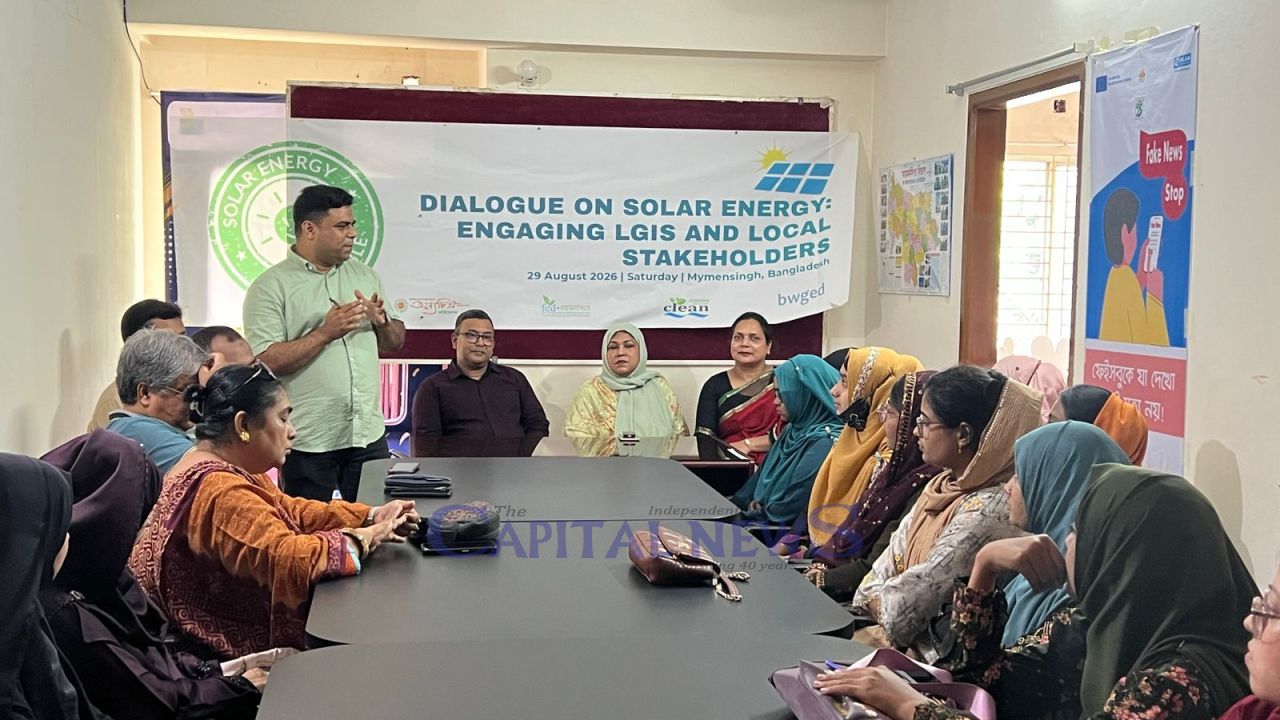
Local Governments urged to lead Rooftop Solar Power Expansion
Rayhan Ahmed, Mymensingh Bureau: Local government institutions should take the lead in
expanding rooftop solar power as Bangladesh faces rising electricity demand,
growing dependence on fossil fuels and increasing climate-related risks,
speakers said at a dialogue in Mymensingh on Saturday.They said rooftops of homes, businesses, educational
institutions, healthcare facilities, markets and government buildings could
become an important source of clean electricity if local authorities,
communities, private-sector actors and financial institutions work together.The views were expressed at a dialogue titled
“Dialogue with Representatives of Local Government Institutions and Local
Stakeholders”, held at the meeting room of Paribartan Unnayan Sangstha in
Mymensingh.The programme was jointly organised by the Coastal
Livelihood and Environmental Action Network (CLEAN), Onnochitra Foundation and
the Bangladesh Working Group on Ecology and Development (BWGED). Selima Begum,
president of FED-Mymensingh, chaired the programme.Speaking at the event, Selima said discussions on
renewable energy should not remain confined to the national level.“People at the grassroots must be involved in the
transition to renewable energy,” she said, stressing that local governments,
social organisations and community leaders could jointly encourage the
installation of rooftop solar systems in homes, businesses and institutions.She also said public interest in solar power could
grow if its economic and environmental benefits were explained to people in
simple and accessible language.“Local government institutions can become the closest
partners of the people in this effort,” she added.Mymensingh District Information Office Director Mir
Akram Uddin Ahmed, the chief guest at the programme, said a lack of adequate
information remains one of the major obstacles to wider adoption of rooftop
solar power.Many people, he said, still do not have a clear
understanding of the benefits of solar electricity, the installation process,
costs and its long-term advantages.He suggested that district information offices, local
government bodies and non-governmental organisations could jointly conduct
awareness campaigns.Successful solar projects should also be showcased
before the public so that people can develop greater confidence in the
technology, he said.Women and marginalised communities need priorityNaznin Sultana, deputy director of the Department of
Women Affairs in Mymensingh and a special guest, said the expansion of
renewable energy is closely linked to social and economic development.Reliable electricity can support women entrepreneurs,
small businesses, education and household-based productive activities, she
said.Therefore, women and marginalised communities should
receive particular attention in awareness and renewable-energy programmes, she
added. Another special guest, Rebecca Sultana, executive director of Onnochitra
Foundation, said a large number of rooftops in urban and semi-urban areas
remain underutilised.“These rooftops can be used to generate solar
electricity, helping reduce pressure on the national grid,” she said.According to her, rooftop solar can help Bangladesh
reduce dependence on fossil fuels, cut carbon emissions and strengthen energy
security at the local level.But achieving this, she said, would require effective
coordination among local governments, financial institutions, the private
sector, solar service providers and ordinary citizens.Participants in the dialogue said local government
institutions could lead by example by installing solar systems on their own
offices as well as on educational institutions, health centres, markets and
other public buildings.They suggested that local authorities could also
identify suitable rooftops, organise public-awareness programmes, connect
potential users with qualified solar service providers and incorporate
renewable energy into local development plans.Speakers placed particular emphasis on access to
affordable financing, quality solar equipment, technical assistance and regular
maintenance.They said these measures would help address some of
the practical concerns that discourage households and institutions from
investing in rooftop solar.The participants stressed that rooftop solar should
not be viewed merely as an alternative source of electricity. Rather, they described
it as a practical pathway towards locally produced clean energy, greater
climate resilience and sustainable development.The programme concluded with a call for stronger
participation and coordinated initiatives by local government institutions to
expand rooftop solar power in Mymensingh and other parts of Bangladesh.