


Ali Ahmad Mabrur: Every year, 27 October returns as a painful reminder that the tragedy of Kashmir is not merely a dispute over territory, borders or constitutional arrangements. It is the story of a people whose political future has been contested for generations, whose aspirations have repeatedly been subordinated to state power, and whose struggle for dignity and self-determination remains unresolved. For Kashmiris and their supporters around the world, the day is observed as Kashmir Black Day, marking the arrival of Indian troops in Srinagar on 27 October 1947. Nearly eight decades later, the central question remains unanswered: can a political settlement be considered complete when the people at its heart continue to demand a meaningful voice in determining their own future?
The events of October 1947 remain central to the Kashmiri understanding of this history. For those observing Kashmir Black Day, the arrival of Indian troops symbolizes the beginning of a prolonged struggle over political control and self-determination. India maintains that Jammu and Kashmir acceded to it legally; many Kashmiris and Pakistanis contest the political legitimacy of the resulting arrangement and point to the commitments made at the time concerning the wishes of the people. The dispute subsequently reached the United Nations, whose Security Council adopted Resolution 47 in April 1948. The resolution envisaged a process involving a ceasefire, a truce and a plebiscite, subject to specified conditions. That process was never completed. The promise of allowing Kashmiris to determine their political future consequently became one of the most enduring and bitterly contested questions in South Asian history.
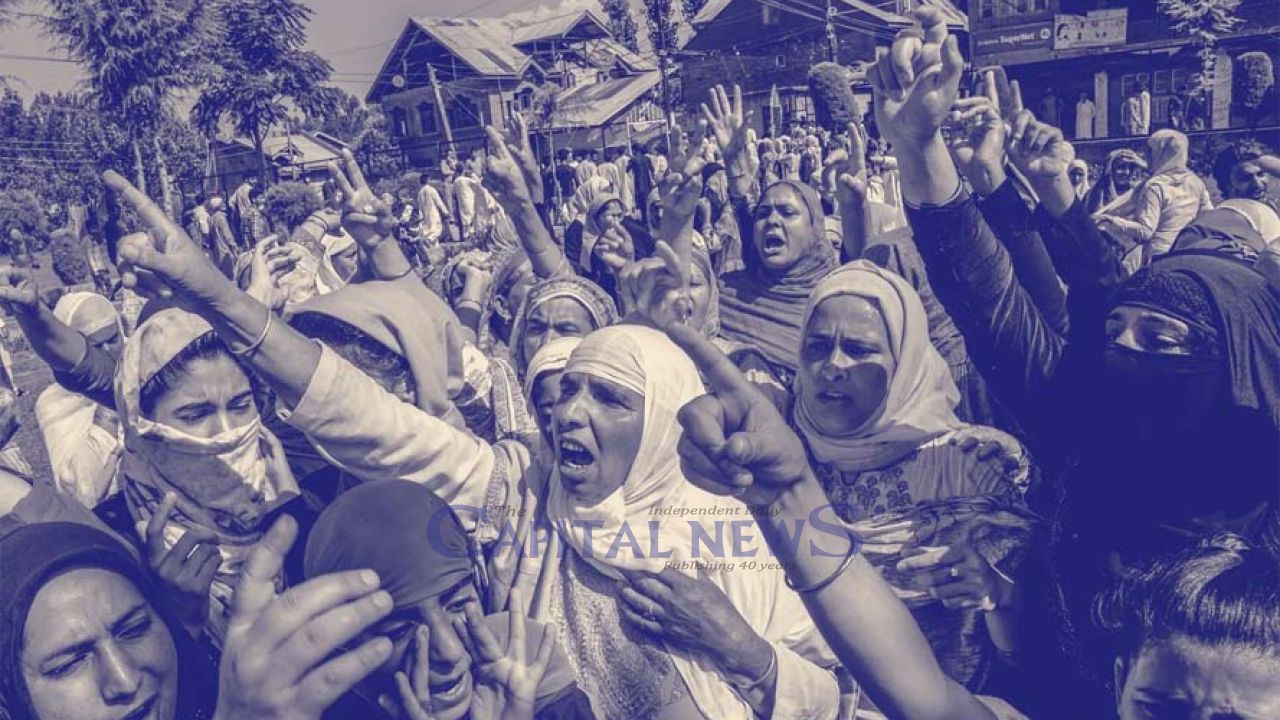
For Kashmiris, the failure to resolve this question has meant far more than diplomatic stalemate. It has shaped family histories, interrupted education, restricted political participation, displaced communities and exposed generations to violence and uncertainty. The consequences are not measured only in the casualties of armed conflict or the number of people detained. They are also found in the anxiety of parents waiting for children to return home, the lives disrupted by curfews and communications restrictions, the fear surrounding political expression and the erosion of the ordinary freedoms that allow individuals and communities to live with dignity.
Kashmir Black Day therefore speaks not only to what happened in 1947 but also to the decades that followed. It recalls a political question left unresolved, a population divided by borders and competing claims, and a society whose aspirations have repeatedly collided with the priorities of powerful states. The anniversary is a demand that the human dimension of Kashmir be placed at the centre of the debate, rather than treating its people as incidental to a contest over territory.
The human consequences of this unresolved political conflict are visible in the lives of individual Kashmiris. Sometimes they appear not in dramatic confrontations or military operations but in the smallest details of everyday existence: a telephone that cannot be used freely, a family waiting for a detained relative, or an electronic device that continues to monitor someone after release from prison.
Since 1947, Kashmir has repeatedly been presented through the language of security. Armed attacks, militant violence, cross-border infiltration and the killing of civilians have all formed part of the region’s painful history. Kashmiri Muslims, Kashmiri Hindus, Sikhs and others have suffered from violence and displacement. The exodus of Kashmiri Pandits in the early 1990s was a devastating tragedy that deserves recognition, remembrance and justice.
But acknowledging one community’s suffering must not require silencing another’s. The displacement of Kashmiri Pandits cannot justify dismissing the political aspirations of Kashmiri Muslims, just as the suffering of Kashmiri Muslims cannot erase the persecution experienced by Pandits. The concern is that the security narrative has frequently become the dominant lens through which Kashmiri political expression is interpreted. Demands for autonomy, independence or implementation of political commitments may be treated as security problems rather than examined as expressions of a longstanding dispute.
For Kashmiris, the daily experience of political control can be more immediate than constitutional debate. It may be a fear of speaking openly, uncertainty about a detained relative, or the knowledge that public criticism may carry consequences. These experiences are not captured by official claims of normalcy, tourism figures or the successful completion of elections. Normalcy must also be measured by whether ordinary people can live without pervasive fear and participate in public life without being treated as suspect merely for holding a different political view.
For decades, Kashmir has been represented through contrasting images: a paradise of snow-covered mountains and lakes, a battlefield defined by terrorism, or a strategic territory whose future is to be decided by national power. Each image contains part of a larger reality, but none is sufficient on its own. The expansion of nationalist cinema in India has intensified this struggle over public memory. Films such as The Kashmir Files (2022) and Article 370 (2024) brought Kashmir’s history and politics to large audiences, but critics have argued that their framing privileges particular nationalist interpretations and risks reducing a complex conflict to a story of national unity, security and designated enemies.
The suffering of Kashmiri Pandits is a historical reality, not something that should be denied or diminished. Their displacement deserves serious treatment, and the crimes committed against them must not be excused. The problem arises when a film’s dramatic reconstruction is presented to audiences as a complete account of history, when contested interpretations are treated as unquestionable fact, or when the suffering of one community is used to cast collective suspicion upon another.
Kashmiris need more than to be spoken about. They need the freedom to speak for themselves—to write, report, organize, remember and disagree without being forced into narratives designed elsewhere. A society’s history cannot be resolved through cinema alone, and its political future cannot be settled by the repetition of a preferred national story.
Kashmir Black Day should not be reduced to a ritual of competing national statements. It should be an occasion to reconsider a conflict that has endured for generations and to ask why its central political questions remain unresolved. The day recalls the arrival of Indian troops in Srinagar on 27 October 1947, but its contemporary significance lies in the lives shaped by the decades that followed.
For Kashmiris, remembrance includes those killed in the conflict, families separated by borders, people who have experienced detention, communities driven from their homes, journalists who have struggled to report freely and young people whose futures have been shaped by prolonged uncertainty. It also includes those who continue to insist that their political aspirations deserve to be heard.
The political dispute also requires serious engagement with the commitments, proposals and diplomatic processes that have shaped Kashmir’s history. United Nations involvement and the competing interpretations of its resolutions remain part of that record. Any durable approach must confront the distance between the political aspirations expressed by Kashmiris and the arrangements imposed or defended by the states claiming authority over the region.
India, Pakistan and other relevant actors have responsibilities, but the people of Kashmir must not remain secondary participants in decisions about their own future. The security concerns of states cannot permanently substitute for political consent. Nor can the language of development, integration or territorial integrity alone resolve a conflict rooted in competing understandings of legitimacy and self-determination.
Ultimately, Kashmir’s future cannot be secured through surveillance devices, restrictive political arrangements or films that offer simplified versions of a complicated history. Nor can the conflict be resolved by treating the territory as a prize to be claimed while its inhabitants are expected to accept decisions made for them. Peace must be measured not only by the absence of visible unrest but by the presence of freedom, dignity, justice and genuine political participation.
Nearly eight decades after the arrival of Indian troops in Srinagar, Kashmir remains burdened by an unresolved political future and the consequences of prolonged conflict. Kashmir Black Day is a reminder that history cannot be settled by territorial claims alone. A government may administer a land, rewrite its constitutional arrangements and declare a political question closed. But no declaration can erase the memories of families, the demands of a people or the need for justice. Until Kashmiris can participate freely and meaningfully in determining their future, the story of Kashmir will remain unfinished—and 27 October will continue to stand as a day of mourning, remembrance and an enduring demand for freedom.
Author: Ali Ahmad Mabrur is a writer, columnist, translator and political analyst.
Subject : Op-Editorial
সোমবার, ২৬ অক্টোবর ২০২৬
Publish Date : 26 October 2026




Write Your Opinion