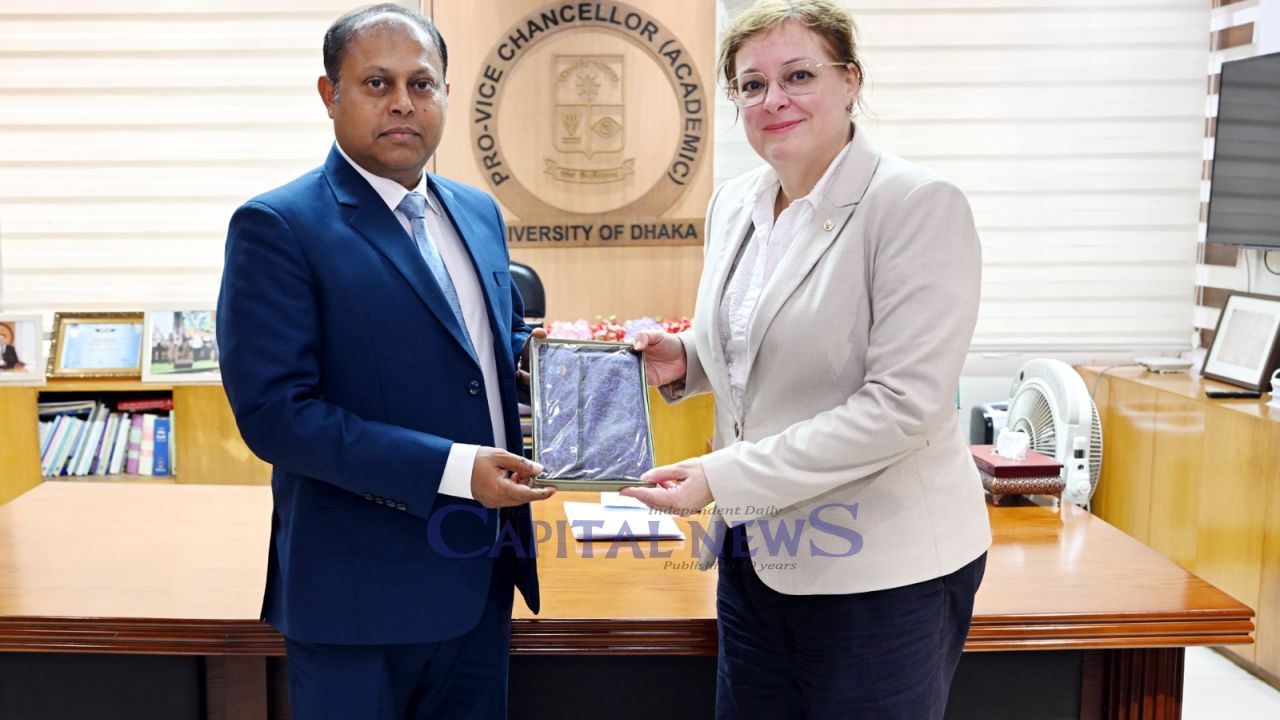
DU, Stockholm University to hold high-level dialogue on Black Carbon
DU Correspondent: The University of Dhaka
(DU) and Sweden’s Stockholm University, in collaboration with the Clean Air
Fund, will jointly organise a high-level Science-Policy Dialogue on Black
Carbon and other Short-Lived Climate Pollutants (SLCPs) on November 1, bringing
together scientists, policymakers and international experts to explore
solutions to air pollution and climate change in South Asia.The day-long event will
be held at the Pan Pacific Sonargaon Hotel in Dhaka, focusing on how
science-based policies can reduce harmful air pollutants, improve public health
and help tackle climate change.State Minister for
Environment, Forest and Climate Change Shaikh Faridul Islam will attend the
inaugural session as the chief guest. Advisor to the Prime Minister and
spokesperson for the Prime Minister’s Office Dr Mahdi Amin, Principal
Coordinator (SDG Affairs) at the Prime Minister’s Office Prof Dr S M Abdul
Awal, and Swedish Ambassador to Bangladesh Nicolas Weeks will attend as special
guests. DU Pro-Vice Chancellor
(Academic) Prof Dr Abdus Salam will deliver the welcome address and outline the
objectives and programme of the dialogue. The initiative comes at
a time when South Asia faces mounting pressure from worsening air pollution and
the growing impacts of climate change. The region is particularly vulnerable to
extreme weather, rising sea levels and threats to food and water security, with
consequences for public health, livelihoods and economic growth. Black carbon, a major
component of soot produced by the incomplete burning of fuels, is a short-lived
climate pollutant that contributes to global warming. Along with other SLCPs,
it can also affect air quality and human health. Experts consider reducing
these pollutants an important opportunity to deliver climate and public-health
benefits simultaneously. The dialogue will bring
together leading scientists, government officials, representatives of
international organisations, civil society members, business leaders and other
stakeholders to examine how scientific evidence can inform practical policy
decisions. Discussions will focus
on identifying priority areas for reducing SLCP emissions, strengthening
atmospheric monitoring and verification, assessing environmental and health
risks, and developing effective climate and clean-air policies tailored to the
needs of South Asia. The event will also
highlight the longstanding scientific and policy cooperation between Bangladesh
and Sweden in atmospheric research, climate change and air pollution
management. A key milestone in this
partnership is the Bangladesh Climate Observatory Bhola (BCOB), jointly
operated by the University of Dhaka and Stockholm University since 2013. The
observatory has provided a platform for atmospheric research and scientific
collaboration. The dialogue will also
revisit the Bangladesh-Sweden policy dialogue held in Dhaka in 2011, which
helped advance international cooperation on short-lived climate pollutants and
contributed to the wider momentum behind the Climate and Clean Air Coalition
(CCAC). Organisers expect the
meeting to strengthen links between scientific research and policymaking,
encouraging governments and other stakeholders to translate evidence into
effective action.
By bringing researchers
and decision-makers to the same table, the dialogue aims to advance regional
cooperation on cleaner air and climate protection, while supporting healthier
communities and more sustainable economic development across South Asia.