

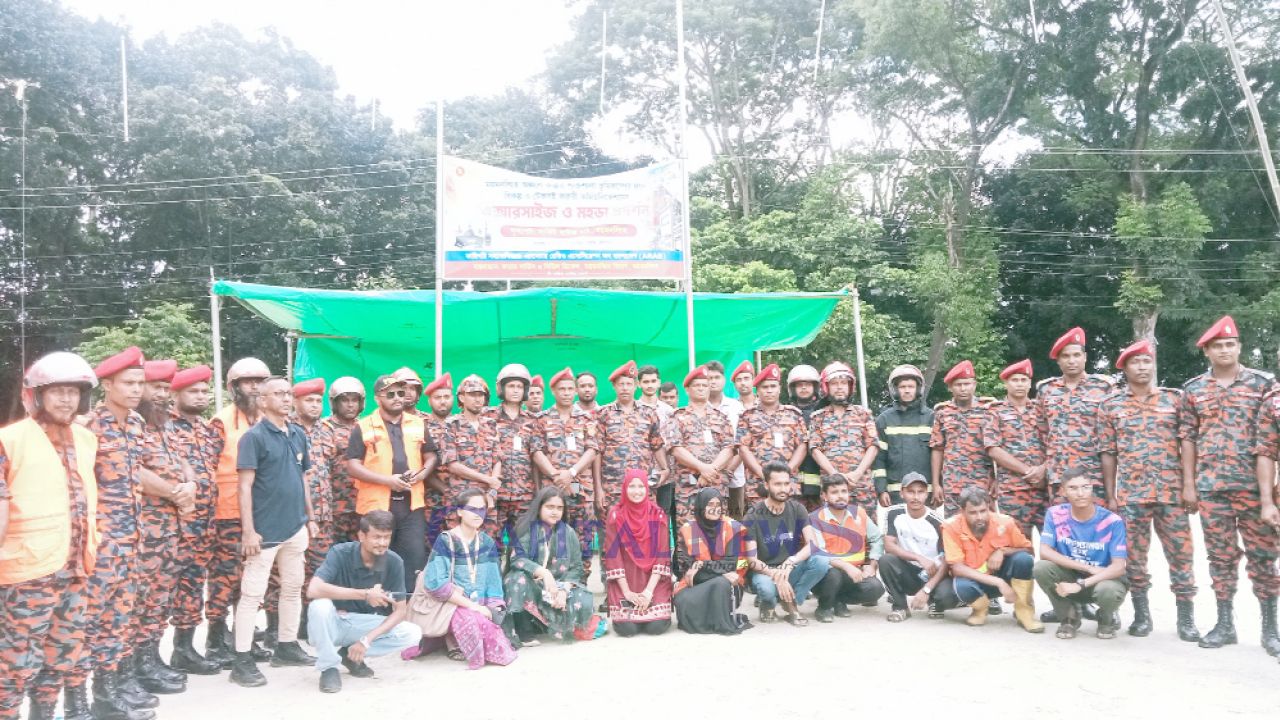
Rayhan Ahmed, Bureau Chief: A major emergency communication and rescue drill was held in Mymensingh on Sunday to strengthen preparedness for a possible powerful earthquake and other large-scale disasters.
The drill, organised at 11am at the Circuit House ground in Mymensingh city, focused on alternative and reliable emergency communication systems, modern rescue techniques and better coordination among emergency response agencies.
The programme was conducted by the "Life Saving Force" of the Fire Service and Civil Defence, Mymensingh Division, with technical support from the Amateur Radio Association of Bangladesh (ARAB). Similar drills were held simultaneously in eight divisions across the country.
A key objective of the exercise was to raise public awareness about earthquake preparedness. A large number of students and teachers from different schools and colleges attended the event and observed the rescue operations. Local volunteers also took part actively in the drill.
Their participation demonstrated how students, teachers, volunteers and emergency responders can work together during a major disaster, organisers said.
Mymensingh city is considered vulnerable to earthquake-related disasters because of its geographical setting and unplanned urbanisation. Against this backdrop, the drill demonstrated practical rescue operations that could be required after a powerful earthquake.
Responders first demonstrated how to assess the surroundings of a damaged or collapsed building before beginning rescue work. The assessment is essential because unstable structures, broken electrical lines, gas leaks and other hazards can put rescuers at risk. The teams then demonstrated the line search method, a systematic technique used to locate people trapped beneath debris or those reported missing.
After identifying the possible location of a victim, rescuers demonstrated how heavy concrete, metal and other obstacles could be removed carefully to reach injured people and provide them with emergency medical assistance. Another important part of the exercise was emergency communication.
Officials said conventional communication systems, including mobile phone networks and internet services, could become unavailable or severely disrupted following a major earthquake. Damage to electricity infrastructure and telecommunications networks could significantly delay rescue operations.
The drill therefore demonstrated how emergency information could be exchanged and coordination maintained among different response teams through alternative communication arrangements. Officials stressed that disaster preparedness should not be limited to rescue operations after an earthquake occurs.
Advance planning, proper application of search-and-rescue techniques and dependable alternative communication systems are equally important to reduce casualties and minimise damage. Fire Service and Civil Defence Deputy Director Mohammad Jane Alam attended the programme as the chief guest.
District Commander Purna Chandra Mutsuddi, PFM, supervised the overall activities, while Deputy Assistant Director Mohammad Mofazzal Hossain, PFM, led the implementation of the drill.
Foreman Mohammad Sirajul Islam, Senior Station Officer Muhammad Sanwar Hossain, Warehouse Inspectors Mohammad Kabirul Alam and Mohammad Abdul Malek, Station Officers Mohammad Julhas Uddin and Mohammad Habibur Rahman, Assistant Communication Engineer Mohammad Mizan and other officials also took part in the exercise.
The organisers said such drills are essential for improving coordination among emergency response agencies and increasing public awareness.
They also emphasised that regular training and practical exercises can help emergency personnel, volunteers and ordinary citizens respond more effectively when a major earthquake or other disaster strikes.
The Mymensingh exercise thus highlighted a simple but crucial lesson: preparedness, communication and coordinated action can save lives when disaster strikes.
সোমবার, ২৪ আগস্ট ২০২৬
Publish Date : 24 August 2026

Write Your Opinion