

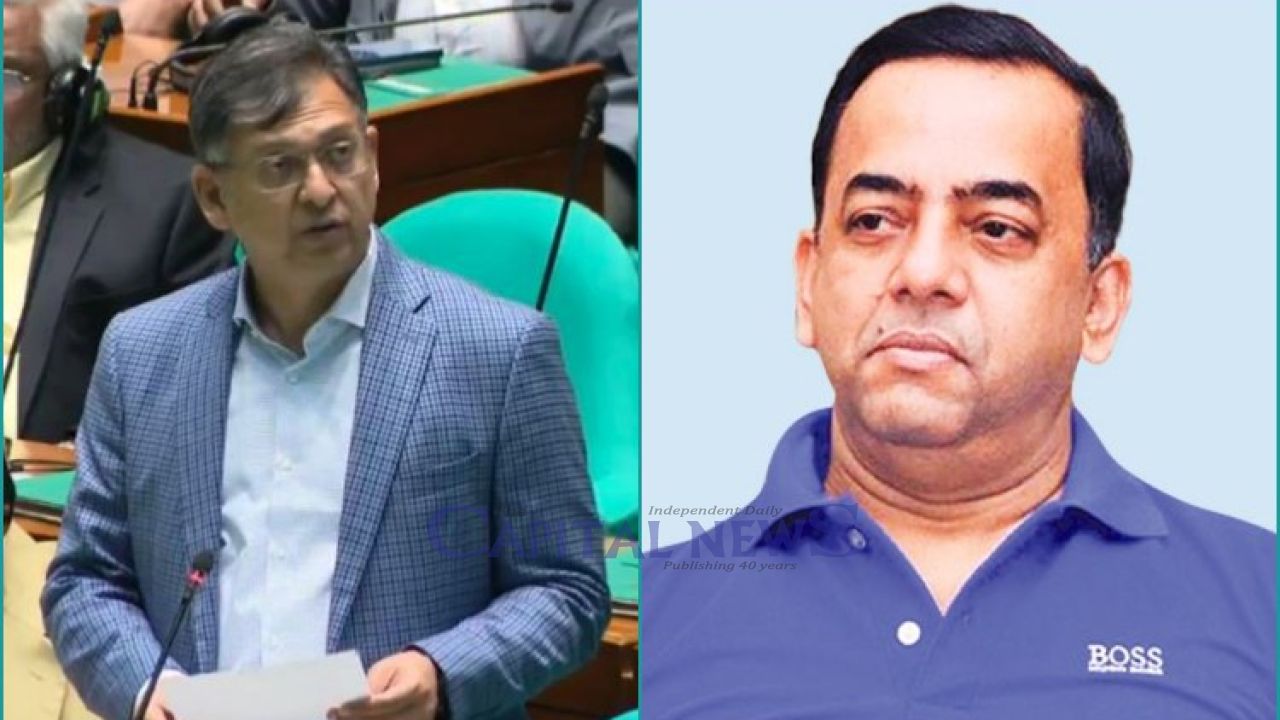
Parliament Correspondent: Former Inspector General of Police (IGP) Benazir Ahmed, who is facing multiple corruption cases in Bangladesh, has been arrested in the United Arab Emirates (UAE) following an Interpol Red Notice and will be brought back to the country through the formal extradition process, Home Minister Salahuddin Ahmed informed Parliament on Monday.
Making a statement under Rule 300 of the Rules of Procedure at the beginning of the day's proceedings in the Jatiya Sangsad, the minister said UAE authorities had arrested Benazir Ahmed in compliance with international legal procedures and were currently holding him in custody.
“I am informing this august parliament and the entire nation that former IGP Benazir Ahmed, who is accused in corruption cases, has been arrested by the police authorities of the United Arab Emirates and is currently being held in custody there,” the Home Minister told lawmakers.
According to the minister, the arrest was carried out after extensive coordination between Bangladesh's National Central Bureau (NCB) and Interpol. He described the development as a “historic success” for Bangladesh Police and a significant step towards ending the culture of impunity.
“This is a historic success of Bangladesh Police. Through this achievement, we will be able to come out of the culture of impunity and lawlessness,” he said amid desk-thumping by lawmakers.
Salahuddin Ahmed said that after the current government assumed office, NCB Dhaka under the Police Headquarters was tasked with working closely with Interpol to ensure that Benazir Ahmed could not evade justice while staying abroad.
He informed Parliament that NCB Dhaka formally requested Interpol on April 11, 2025, to issue a Red Notice against the former police chief. Following a series of international communications and legal procedures, Interpol issued the notice and requested the UAE Ministry of Interior to take necessary action.
Bangladesh officially received confirmation of the arrest on June 12, 2026, through an email sent by the Directorate General of Federal Criminal Police, National Central Bureau (NCB) Abu Dhabi, the minister said.
The UAE authorities have informed Bangladesh that, under UAE Federal Law No. 39 of 2006, a formal extradition request must be submitted through diplomatic channels within 30 days of the arrest.
Benazir Ahmed is facing several criminal cases in Bangladesh under Sections 420, 467, 468 and 471 of the Penal Code, provisions of the Prevention of Corruption Act, 1947, and Section 11 of the Bangladesh Passport Order, 1973.
The Home Minister said all relevant government agencies were working in coordination to complete the legal and diplomatic procedures necessary for the former police chief's return.
He said the Anti-Corruption Commission (ACC) was preparing the required case records, arrest warrants and investigation documents, while the Ministry of Home Affairs would finalize the extradition proposal. The Ministry of Foreign Affairs, he added, would formally convey the request to the UAE authorities through diplomatic channels.
“Through close coordination with NCB Abu Dhabi and the relevant authorities of the UAE, we will bring him back to Bangladesh as quickly as possible,” he said.
The minister emphasized that the arrest sends a strong message that no individual, regardless of rank, position or influence, is beyond the reach of the law.
“We want to assure the nation that no criminal is above the law, no matter how powerful he or she may be. This action demonstrates the government's commitment to ensuring accountability and justice,” he said.
Describing the arrest as a landmark achievement, Salahuddin Ahmed said it would strengthen public confidence in the country's justice system and reinforce the government's commitment to fighting corruption.
“This will remain a historic milestone in establishing the rule of law in Bangladesh. It proves that those accused of serious crimes and corruption cannot escape justice simply by leaving the country,” he added.
Shibir Leader's Disappearance Not Linked to Enforced Disappearance
In a separate statement under Rule 300, the Home Minister also addressed the reported disappearance of Bangladesh Islami Chhatra Shibir central leader Mohammad Jisan Mia Pradhan, saying police investigations had found no evidence linking the matter to any enforced disappearance or government action.
He said a General Diary (GD) was filed at Daudkandi Model Police Station in Cumilla on June 12 after Jisan was reported missing. Police subsequently launched an investigation and search operation.
According to the minister, investigators found that Jisan had developed a relationship with a woman through Facebook and allegedly promised to marry her. Police inquiries revealed that the two had maintained a physical relationship, resulting in the woman's pregnancy.
The minister said Jisan allegedly pressured the woman to terminate the pregnancy and arranged abortion medication through associates. When the woman later demanded marriage, Jisan reportedly agreed to marry her on June 12 but went into hiding a day earlier. A missing diary was subsequently lodged on his behalf.
Police later traced and recovered him from Laksham in Cumilla district.
Following the incident, the woman filed a case against Jisan and three others on allegations including rape, abetment of rape, criminal intimidation and causing miscarriage. The co-accused were arrested and later gave confessional statements before a magistrate under Section 164 of the Code of Criminal Procedure.
The Home Minister said the investigation remains ongoing.
He further noted that some social media accounts had attempted to portray the disappearance differently and blame the government, making it necessary to present the verified findings before Parliament and the public.
Subject : Corporate
সোমবার, ১৫ জুন ২০২৬
Publish Date : 14 June 2026





Write Your Opinion